
Departments
Every department is a clinic of its own
Cardiology, orthopedics, oncology and obstetrics each have their own consultants, their own procedures and their own anxious questions. Someone reading about a stent has nothing in common with someone booking an antenatal scan, and a hospital site works when each department answers its own patients as fully as a specialist clinic would.
Most patients, though, do not know which department they need. They know their symptom. So the navigation offers two ways in: an index of departments for the patient who has been referred, and a route by symptom or body part for the one who has not, both arriving at the same department page with its doctors, timings and a way to book.
That structure is also what sets the budget. A hospital with a dozen departments and several consultants in each runs well past the twenty pages of the largest build in our published prices for clinic websites, so it is quoted once the department list is settled.
- Home
-
Departments
- Cardiology
- Orthopedics
- Oncology
- Obstetrics and gynaecology
- and every other speciality
Consultant profiles
Dozens of consultants, every profile current
Each consultant's page needs the same facts: qualifications, registration number, department, OPD days and timings, languages spoken and a way to book. Patients read these pages closely, and a profile for a doctor who left months ago does more damage than a missing one.
That makes profiles a content management problem before a design one. Each doctor is kept as one record feeding their profile, their department page and the booking form, so a change is made once. Before design starts, the hospital names who owns the records, how a joining or a departure reaches the site, and how often the whole list is checked.
Feeds the profile page, the department page and the booking form.
Emergency
The one page read in a panic
Nobody browses an emergency page. They reach it from a search or a link a relative sent, on a phone, frightened, sometimes already in a taxi. What they need, in this order, is the emergency number as a button that dials, the address, and directions that open in their own maps app.
Everything else waits. The page has no carousel, no pop-up and no welcome video, and it is the lightest page on the site so that it loads on a weak connection. It says which gate the emergency entrance is on, whether the hospital runs an ambulance and how to call it, and where to park. The emergency number also sits in the header of every page, so most people never need to find this one.
Insurance and health checks
The pages patients check before they come in
Can I go cashless here? Few questions bring more people to an Indian hospital's website, and the answer is usually a scanned PDF of insurer and TPA names, undated and three clicks deep. On a phone nobody can search it, so the insurance desk takes the calls instead.
Built as a page, the list can be searched by insurer and by TPA, marks cashless and reimbursement plainly, says what to bring for pre-authorisation, and gives the insurance desk's own number and hours. It carries the date it was last updated, because a stale list sends a patient to the wrong counter at the worst possible time.
Health check packages are products
Preventive health checks have search demand of their own, usually with a city and a price attached. Each package deserves a page listing the tests it includes, the preparation it needs, how long the visit takes and what it costs, instead of sharing one brochure with every other package.
Beyond patients
Three more audiences, three more routes
Patients are the largest audience, not the only one. Each of the others arrives with a question the patient pages never answer, and gets a section of its own.
Referring doctors
A GP sending a patient wants what the patient pages leave out: which procedures a department performs, how to reach the consultant directly, and a referral form that reaches a person the same day.
Patients from elsewhere
Families travelling from another state or country need logistics before medicine: an estimate before they set out, the documents to bring, somewhere to stay nearby, and one named contact who replies.
Job applicants
Nurses, technicians, pharmacists and doctors apply in real numbers, mostly from a phone. Openings listed by department and shift, with a short application, keep them out of the appointment form.
The advertising code
What the code lets a hospital say
The medical advertising code gives institutions a permission of their own. A hospital may publish factual information about itself: its name, the kinds of patients it admits, the facilities and services it offers, and its fees. That covers most of what a good hospital site contains, from department pages to health check prices.
Two things stay off it. One is a campaign built around a single consultant, because the hospital cannot promote a doctor in a way that doctor could not promote themselves; a profile states facts and does not sell. The other is outcome claims. Success rates, survival figures and first-in-the-region boasts are the same claims from a hospital as from a clinic.
Accreditation is different. NABH accreditation, or an equivalent, is a checkable fact about the institution, and stated plainly with its scope and validity it belongs on the site. Our guide to India's medical advertising rules sets out where each line falls and why.
Our hospital work
Jupiter Hospital
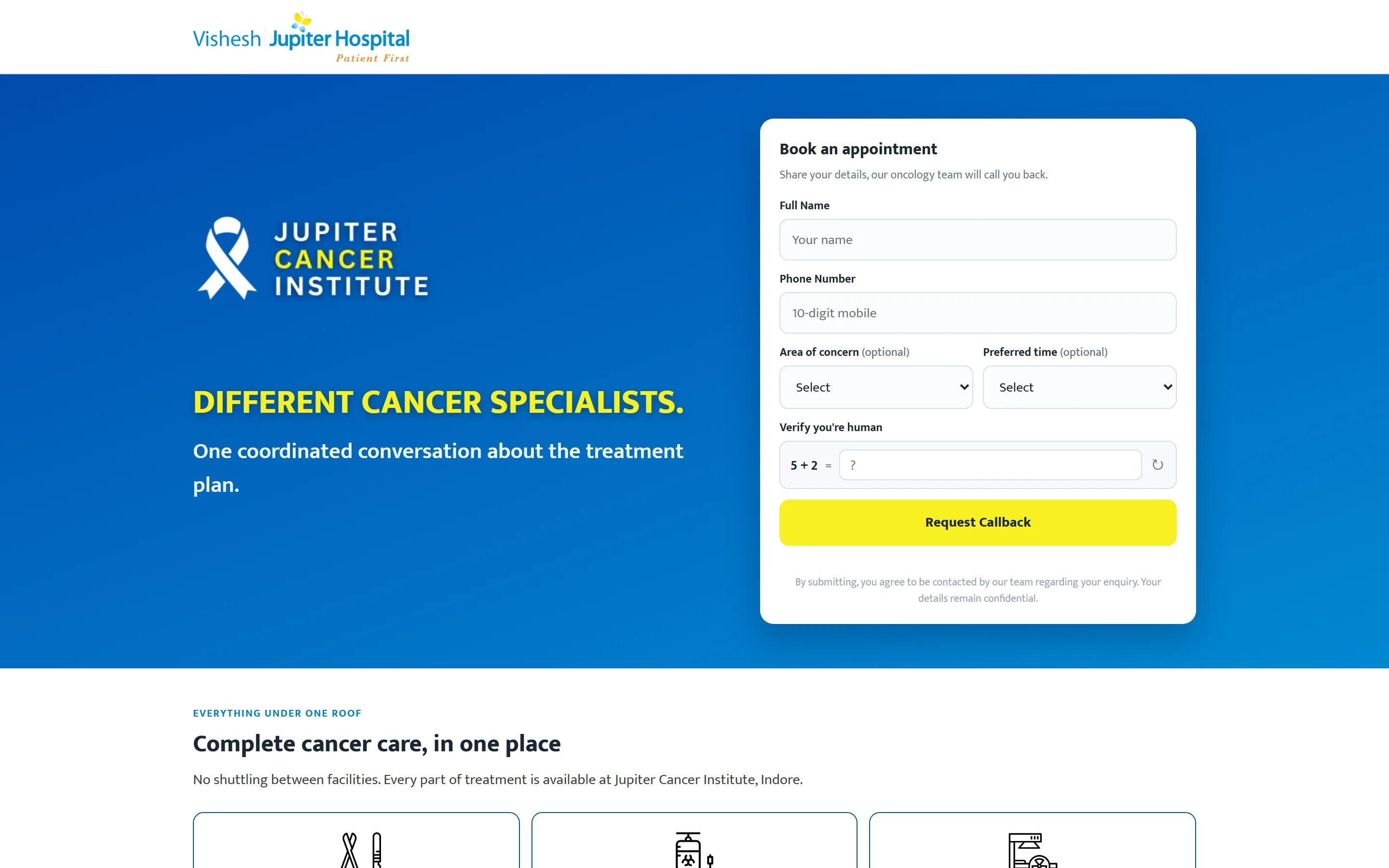
Jupiter has hospitals in four cities: Thane, Pune, Indore and Dombivli. Our part is the sites around its main one, built for particular campaigns and for individual departments.
One of them serves the Jupiter Cancer Institute in Indore. It explains six areas of cancer treatment for patients rather than for clinicians, carries a profile for each of its seven consultants, and asks anyone booking which concern brings them and when they would like to be called.
A department site like that is the unit a hospital site is assembled from: one speciality, its consultants, its patients' questions and its own route to an appointment. Our main page on websites for doctors and clinics covers the rest of this work, and our work page shows the studio's other projects.
FAQ